
The short answer
If your heater blows cool air, cycles on and off, makes new noises, or leaves some rooms cold, it likely needs repair. PrecisionFix diagnoses the cause, explains your repair or replacement options and the cost before any work starts, and offers 24/7 emergency service in Palo Alto and nearby cities.
Palo Alto winters are mild, but cold, damp nights still make a working heater matter. When your furnace, heat pump, or wall heater stops keeping up, PrecisionFix HVAC Repair Service finds the cause, explains it in plain terms, and fixes it. We serve homeowners in Palo Alto and nearby cities, including Menlo Park, Mountain View, Los Altos, and East Palo Alto. This page covers the warning signs to watch for, what our technicians inspect, how we think about repairing versus replacing, what affects the cost of a repair, and what to expect from a visit. If your heat goes out at night or on a weekend, we offer 24/7 emergency service.
Signs Your Heating System Needs Repair
The Santa Clara Valley has mild, damp winters, so many heating systems sit unused for months and then run hard during a cold snap. That pattern can expose problems that were developing quietly. Call for a repair if you notice any of these:
If you smell gas, leave the house right away. Call your gas utility or 911 from outside before you call us. A faint dusty smell the first time you turn on the heat each fall is usually dust burning off the heating parts, and it fades quickly.
- No heat at all, or the system runs but blows cool air
- Short cycling: the system starts and stops every few minutes
- Some rooms stay cold while others are warm
- New noises such as banging, squealing, grinding, or rattling
- A burning smell that lasts beyond the first few minutes of the season
- A yellow or flickering burner flame instead of a steady blue one on a gas furnace
- Heating bills rising without any change in how you use the system
- A heat pump that frosts over and doesn't clear, or runs constantly without reaching the set temperature
- A thermostat that doesn't respond or has a blank display
What We Check During a Heating Repair Visit
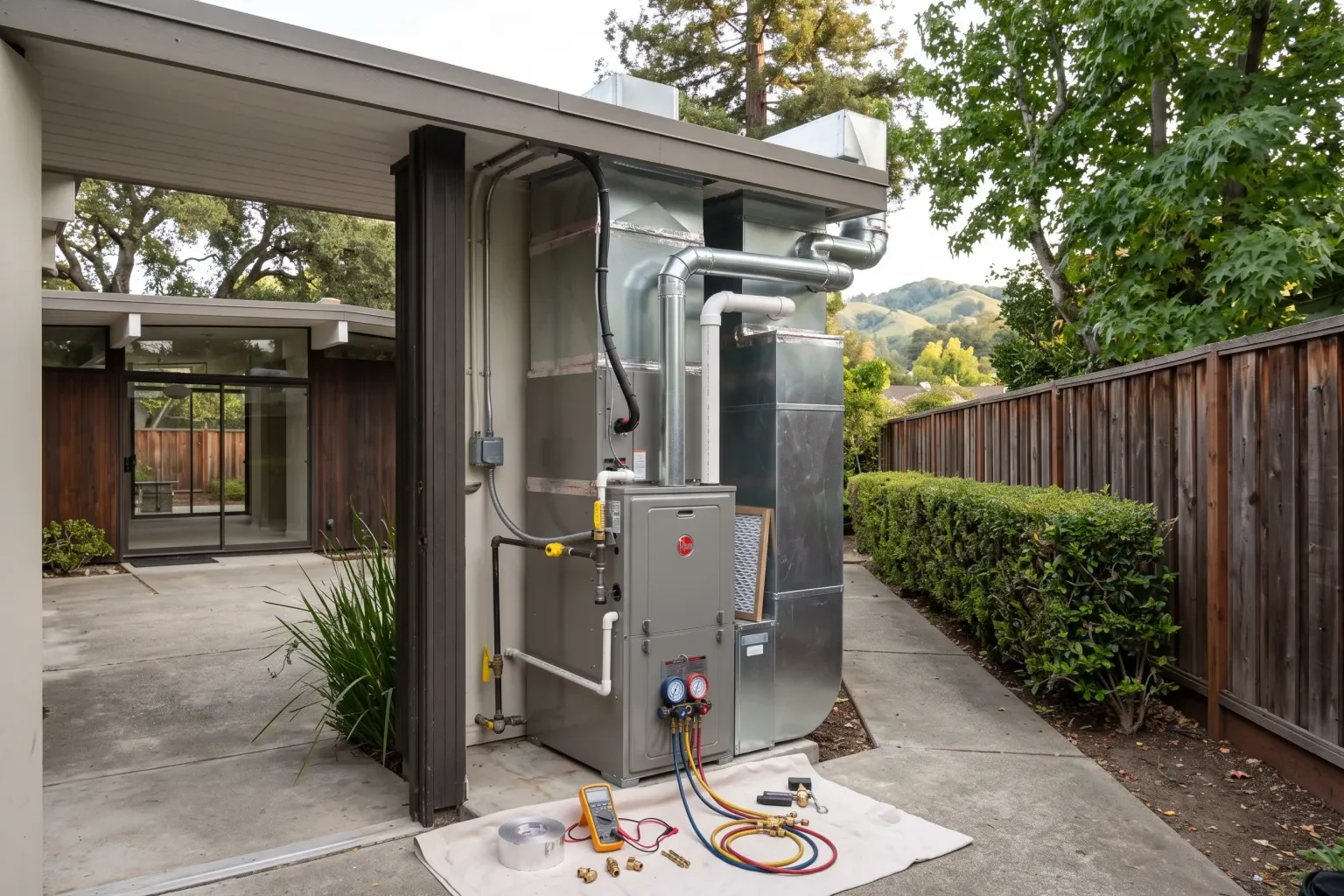
A good repair starts with finding the actual cause, not just the most obvious symptom. Depending on your equipment, our technician will inspect:
We also check for carbon monoxide around gas appliances. If we find something that isn't safe to run, we'll tell you directly and explain why.
- Thermostat settings, wiring, and batteries
- Air filter condition and airflow through supply and return vents
- Igniter, flame sensor, and burners on gas furnaces
- Heat exchanger, looking for visible cracks or signs of overheating
- Blower motor, belt, and capacitor
- Gas pressure and safety controls, including limit and pressure switches
- Flue and venting, looking for blockages or disconnected sections
- Heat pump refrigerant circuit, reversing valve, defrost controls, and outdoor coil
- Electrical connections, fuses, and the control board
- Condensate drain on high-efficiency furnaces
Repair or Replace: How to Decide
Most heating problems can be fixed, and repair is often the sensible choice. A failed igniter, dirty flame sensor, worn capacitor, or clogged drain is a routine fix. Replacement is worth discussing when a major component, such as the heat exchanger or compressor, fails on an older system. It's also worth discussing when repairs are becoming frequent, or when the system can't keep the house comfortable even when it's working correctly.
Local rules also play a part. Under Bay Area Air District Rule 9-4, natural gas furnaces manufactured from 2029 onward must meet a zero-NOx emission standard. In practice, that points homeowners toward heat pumps when they replace a furnace after that date. These rules don't require you to replace working equipment. They apply only when an existing furnace or water heater fails or is replaced. Repairing a furnace now is fine, but if you're facing a major repair on an aging system, it makes sense to consider what a future replacement will look like.
About incentives: the federal Energy Efficient Home Improvement Credit (25C) covered qualifying heat pumps placed in service before December 31, 2025. It isn't available for new installations after that date. Bay Area homeowners can still check BayREN and their local clean energy provider for heat pump and electrification incentives. Amounts and availability change with each funding cycle, so we confirm the current offer before including it in any quote.
We'll explain both options and the reasoning behind each one. The decision is yours.
What Affects the Cost of a Heating Repair
We can't price a repair until we know what's wrong, but these factors drive the final cost:
Before any work starts, we explain what we found and tell you what the repair will cost. Nothing proceeds without your approval.
- The type of system: gas furnace, heat pump, ductless mini-split, or wall heater
- Which part failed, and whether it's a common part or specific to one manufacturer
- Part availability, especially for older or discontinued models
- How easy the equipment is to reach, such as in a tight attic, crawlspace, or closet
- Whether the problem involves refrigerant, gas lines, or electrical work
- Whether the visit happens during regular hours or as an after-hours emergency call
- Related issues found during diagnosis, such as duct leaks or venting problems
How a Heating Repair Visit Works
Here's what to expect when you schedule a heating repair with us:
If a part has to be ordered, we'll tell you how long it may take and whether there's a safe way to keep your home warm in the meantime.
- Scheduling: Tell us what's happening, what kind of system you have, and when the problem started. That helps the technician come prepared.
- Arrival: The technician asks about the symptoms, then looks over the equipment, thermostat, and vents.
- Diagnosis: We test components to identify the cause, not just the symptom.
- Explanation and quote: We show you what we found and explain your options, including repair versus replacement when it's relevant.
- Repair: With your approval, we make the repair, often in the same visit if the part is on hand.
- Testing: We run the system through a full heating cycle to confirm it works and check that the safety controls work.
- Wrap-up: We clean up and share tips on filters and seasonal care.
Heating Repair by city
- Heating Repair in East Palo Alto
- Heating Repair in Atherton
- Heating Repair in Menlo Park
- Heating Repair in Mountain View
- Heating Repair in Redwood City
- Heating Repair in Los Altos Hills
- Heating Repair in Woodside
- Heating Repair in Los Altos
- Heating Repair in Portola Valley
- Heating Repair in San Carlos
- Heating Repair in Newark
- Heating Repair in Sunnyvale